

Remember: “to whom much is given, much is expected”.
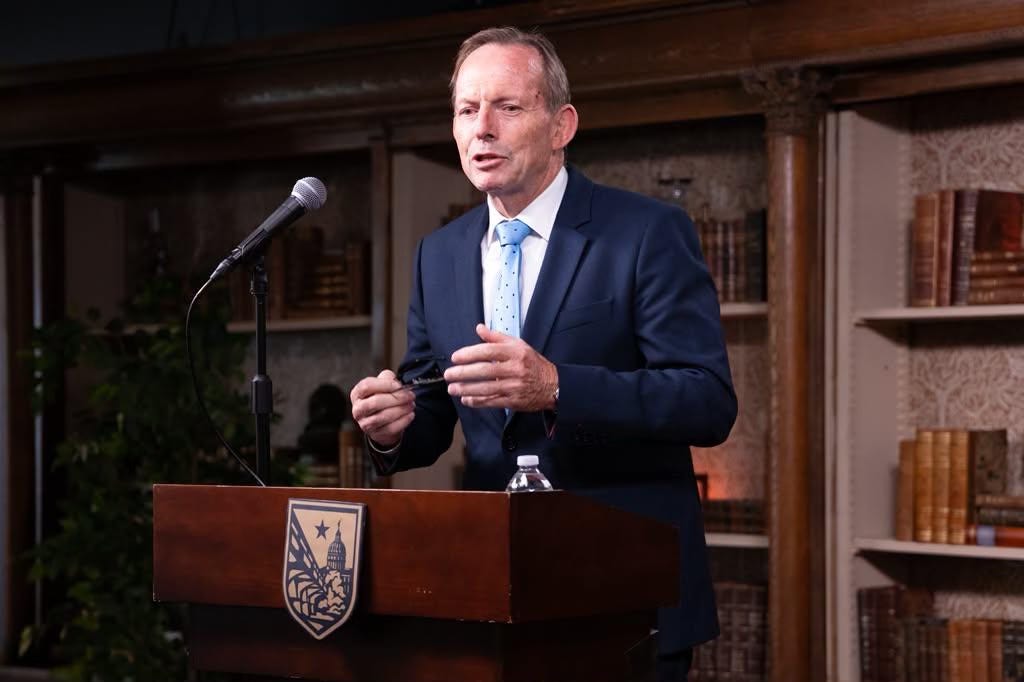
The following is the transcript of a speech I gave to graduates at the University of Austin. I hope it speaks to Australians and indeed all constituent peoples of Western Civilisation.
It’s an honour to be addressing a group of high-achieving students and their justly proud teachers, as you go on improving your minds and then making an impact on the wider world. When I was in your shoes, speeches such as this had an impact on me; and I hope this might have an impact on you. This is especially the case if, as I did, you think that your duty is to make a difference, in a world that could, and should be better.
Challenged from without and from within, there’s now a real danger that we might be living through the twilight of the West, which is facing not just geopolitical challenges, but a civilisational eclipse as people lose the beliefs that once sustained them.
A vicious dictator has invaded Ukraine as part of his dream to restore the Russia of Peter the Great; communist China daily threatens practically independent Taiwan and shouts its determination to be the world’s top power within 25 years; and Iran’s apocalyptic Islamism might have had its war machine degraded, but in the process has badly damaged Western economies and divided America from its key allies. Beijing, Moscow and Tehran are in an informal alliance, a “no limits partnership”, with the sole objective of humbling the West and imposing some version of militarism, Communism, or Islamism.
It’s hard for us, focussed as we are on our families, our neighbourhoods, our workplaces, and a better life for our own people, to grasp the will to power that animates dictators with no comparable domestic constituency to persuade and conciliate. This goes even more so when our countries are grappling with economic stagnation and social division that successive governments seem unwilling or incapable of tackling.
It’s these internal challenges that are actually more serious than the external ones. Since the Global Financial Crisis (but especially since the pandemic), Western living standards have been stagnant or falling, heavy industries have fled offshore, mass migration has changed neighbourhoods and challenged long-held beliefs, and established political parties are disintegrating because they can’t persuade voters that they’re not part of the problem.
Left-wing governments are exacerbating economic stagnation and societal fragmentation because of their addiction to climate action and identity politics. Right wing governments are failing their strongest supporters because they’re hamstrung by quangos and legislation designed to tie their hands and because much of their programme is labelled “racist” or “victim-blaming”, causing many decent people to wash their hands of public life.
Meanwhile, more and more people feel that their country is changing before their eyes through mass migration, de-industrialisation, trans activism and family breakdown.
In a recent essay, the former Labour leader Tony Blair analysed the problems of his country—which, he candidly admitted, the current British government is manifestly failing to address. Essentially, he said there was an economic problem, created by too much regulation and tax, exacerbated by climate ideology, that was comprehensively destroying energy affordability. This compounds a societal problem caused by a morale-sapping welfare system that made it too easy for people not to work; and by out-of-control mass migration, especially illegal migration, which—by “whatever it takes” he said—just has to be brought under control.
For Australia, the issue is not illegal, but legal migration, at sustained record levels (largely set by universities and colleges selling work and residency rather than education and businesses dependent on foreign workers for jobs locals won’t do at current wages). All this endures in the face of the reality of modern Australia. Australia is a settler society, later joined by people from all over the world, attracted by our core Anglo-Celtic culture, the world’s most welcoming, and the foundational Judaeo-Christian ethos, the world’s most universal.
Once upon a time, “new Australians” as we called them, were expected to integrate from day one, invariably by getting a job, paying taxes, and mixing with their fellow Australians. Now, under the doctrine of multiculturalism, they’re officially encouraged to maintain their old identity, not so much joining Team Australia as living in Hotel Australia, and making the most of the facilities, presumably because the Australia they joined is needs changing or diluting.
In many Western countries, there are now minority monocultures uncommitted to any coherent national project, either because they reject the civic values once taken for granted or because they doubt their nation’s fundamental legitimacy. Western Civilisation, especially its English-speaking variant, once seemed unassailable; because what else has produced societies that were free, fair, rich, and safe in a way that no others were.
But that restless curiosity and capacity for self-criticism, that protean capacity for growth and renewal; has now metastasised into a corrosive form of civilisational self-loathing: Americans angst over slavery; Britons angst over the Empire; and Australians and Canadians angst over indigenous dispossession. Even though Americans fought their bloodiest-ever war to be rid of slavery; the British Empire, as Macaulay said, was to enable the native peoples to walk alone in the path of justice; and modern Australia (and Canada) brought science, equal rights, and the rule of law to lands where these fundamental goods had never been known.
This is the deeper malaise bedevilling efforts at economic reform, building social cohesion, or military rearmament—why strengthen that which is not worth strengthening?—even though by any objective standards the countries of the West, the Anglosphere especially, are the most successful the world has ever seen. Billions are eager to call them home. Unlike, say, China, where no outsiders want to live, and those who can strive to get Western passports and potential boltholes. As President Trump said at the recent event for the King, “the sons and daughters of the British Isles went on to found more countries and spread more civilisation than any nation before. They built an English-speaking world upon which the sun never sets and provided an example to which free people will always turn”.
So lest we despair, as an antidote to despondency, let’s remember that these are not the first vexing times, or even the worst.
When I was your age, the Western world was likewise at a low ebb. Saigon had fallen; the Soviets had captured Afghanistan; much of Africa was in the hands of Marxist liberation movements; and the Iranian theocracy had shown its contempt for America by holding hostage its Tehran embassy staff. Stagflation was rampant; a US president had been hounded out of office over Watergate; and after a miners’ strike and a three day working week, Britain had needed an IMF bailout. It was a grim time.
Yet within scarcely a decade, Ronald Reagan, Margaret Thatcher and Pope John Paul II had reinvigorated economies, strengthened militaries, and reminded people that there was a fragrant alternative to soulless materialism: namely love of neighbour, love of country, and love of God. It’s a reminder that change can come quickly with the right leadership. With leaders at every level who encourage people to be their best selves. Because in the end, the world changes, for better or worse, person by person.
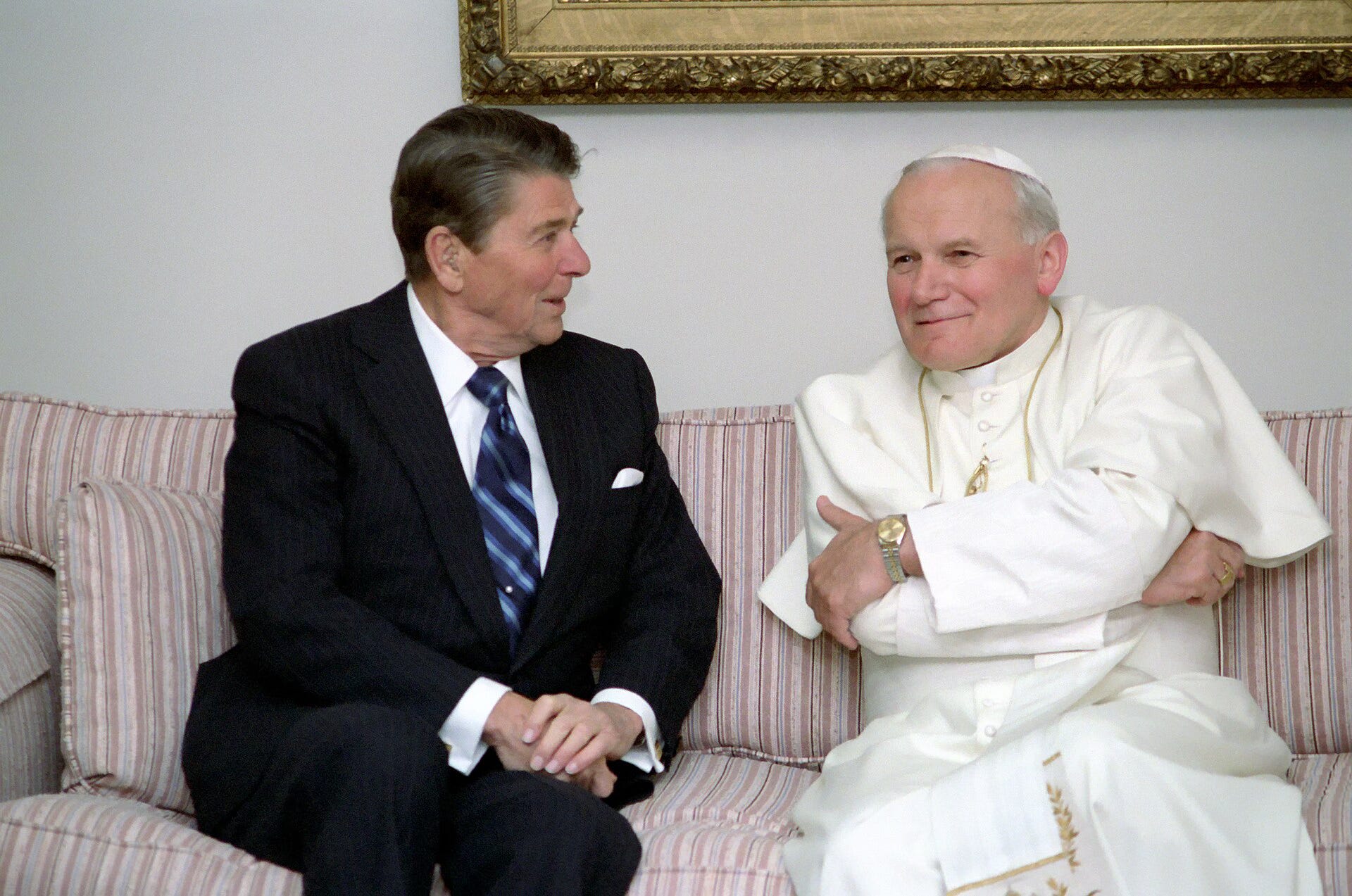
There was rapid improvement in the 1980s and beyond, because a myriad of individuals, most notably these three great global leaders, decided in their own particular circumstances, “to strive, to seek, to find and not to yield”. Western Civilisation is worth believing in, and it is worth fighting for, but that presupposes a widespread appreciation of its strengths as well as its weaknesses.
This is where you come in: the students of the University of Austin, Texas. UATX is a university especially set up to imbue tomorrow’s leaders with the best that’s been thought and said, starting with the Western canon: the Hebrews, the Greeks, the Romans, and all the other thinkers that have stood the test of time. It’s your great privilege to attend a university where the intellect has been “properly trained and formed to have a connected view of things” in Cardinal Newman’s words; that will “make itself felt in good sense, sobriety of thought, reasonableness, candour, self command and steadiness of view”.
In some, said Newman, “it will have developed habits of business, power of influencing others, and sagacity. In others, it will elicit the talent of philosophical speculation… In all, it will be a faculty of entering with comparative ease into any subject of thought and of taking up with aptitude any science or profession”.
Religion, philosophy, literature, and, perhaps most of all, history—that’s your study here, because the study of history is the study of how the best people of each age have tried to make their times better based on all they knew then.
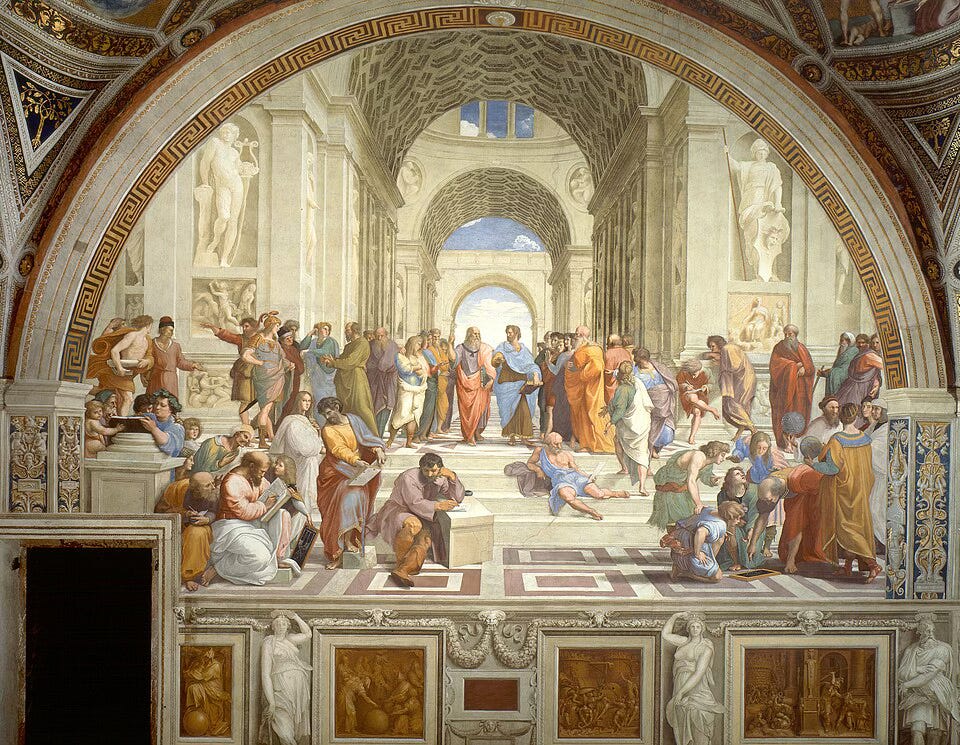
Along with the ever-pressing question: what does it mean to be human? Is human flourishing best guaranteed by limited or unlimited government; is prosperity best advanced by free markets or government control; is freedom best preserved by strict rules or by the interplay of legislature, courts, and a free media; is safety best safeguarded by license or by law; these are the great questions that you ponder.
Because we best approach the true, the beautiful, and the good by interrogating the best thinkers of the past, in the light of the present. We must ask ourselves: “What do their times have to say to our times?”; and then clearly-yet-humbly putting forward a view, in the hope that it will resonate with others.
Human history is not a linear progression. Three steps forward can be followed by four steps backward, as the Dark Ages, the Black Death, the Thirty Years War, and the Great War show. In part, because the line between good and evil runs through every human heart, including our own. Yet, each of us has a sacred duty, derived from God and conscience, to strive for a better world.
A Jesuit mentor routinely reminded me “genus humanum vivit paucis”; Latin for “the human race lives by a few”. Your studies have given you a depth of insight that few others have, because they’ve been critiquing learning rather than savouring it. You’ve largely been spared the paradox of these times: in which never has there such abundance of information, yet rarely has there been such scarcity of the things that really matter: wisdom, judgment, character and a sense of the transcendent. We might very well have been “made weak by time and fate”; but some are, as yet, “strong in will”.
So your job is less to make money and to win acclaim than to build the better country and the better world, that should always be within reach, if each of us, and if all of our countries, are to be our best selves.
And to grasp the moral order, even if only “through a glass darkly”.
Remember: “to whom much is given, much is expected”.
Ask yourself: what sort of a world do you want?
Focus on that, strive to make it happen.
And you might be surprised to discover just how much you can achieve.
Someone will lead America 30 years hence.
Someone will have started the next Amazon or SpaceX.
Someone will have written the book that most uplifts the contemporary world.
Likewise, many could be parents to large families, “ambitious for the higher things”.
That just might be you; so, soberly assess yourself, then put no limits on what you can achieve.
Another great piece from a brilliant mind.