

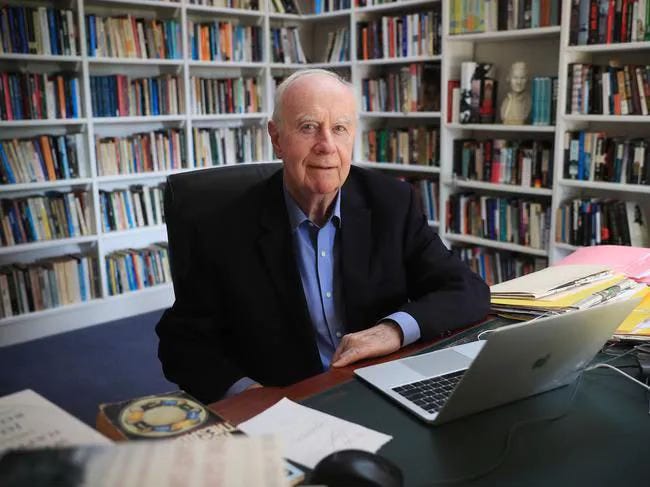
The Twilight of Exceptionalism: The Liberal and Conservative Era 2013–22, Paul Kelly, Melbourne University Publishing, hardcover, 764 pages, released 31 July 2026.
Australia’s best ever political journalist has finally delivered his considered verdict on the most recent period of Coalition government. It’s a lament for the political failures of the conservative side of politics and the consequent declining fortunes of our country. The Twilight of Exceptionalism contrasts the successful politics and transformational economics of the Hawke-Keating-Howard era with the revolving door prime ministerships and largely timid policy-making of subsequent years.
While Paul Kelly is right to dwell on the added difficulties of governing in the era of 24/7 social-media-driven polarisation and outrage, is it really economic stagnation and social fragmentation that’s making government more difficult or is it poor leadership and flawed character that’s creating the conditions for a more rancorous public debate, the triumph of opposition-ism, and the end of any Australian economic and social miracle?
If the Coalition’s period in office does actually turn out to be the twilight of exceptionalism, the 2014 budget was its last twinkling.
One of Kelly’s qualities as a writer and thinker is his determination to give credit where it’s due—plus his appreciation for the fact that real leadership means providing the country with what it needs rather than simply giving voters what they are presumed to want. Kelly laments the passing of an era when good policy ultimately made for good politics and puts it down to a more adversarial public culture, the decline of social capital, and the rise of the sovereign self.
Yet he also writes: “Leadership turbulence over the 2013-22 era was pivotal to the party’s present malaise since everything is ultimately sheeted to leadership”. With hindsight, the success of the Hawke-Keating reforms would seem to owe at least as much to the broad support of the then opposition as to the brilliance of Labor’s leaders. And if it were actually the good character and collegiality of the key people at the top of both the Hawke-Keating and the Howard-Costello governments that was at the heart of their success, compared with the poisonous rivalries that blighted the Rudd-Gillard-Rudd and the Abbott-Turnbull-Morrison era, then our national decline might be less set-in-concrete than it seems from a close study of Kelly’s insightful-yet-elegiac doorstopper of a book.
After one prime ministership that didn’t last a single term, another that ended in a second party room coup, plus a third in heavy electoral defeat, it was probably inevitable that Kelly would dwell on the Liberal-National Coalition’s political failures: mine to keep the party room numbers, Malcolm Turnbull’s to craft a credible “progressive” Liberalism, and Scott Morrison’s to better read the nation’s mood. Still, he abundantly acknowledges the era’s successes: stopping a wave of illegal migration-by-boat, something that no other Western government has achieved in recent times; scrapping the economy-jeopardising carbon and mining taxes and keeping government spending sufficiently-restrained to deliver significant tax cuts; navigating the same-sex-marriage debate via a plebiscite that didn’t exacerbate social divisions; and the AUKUS agreement for Australia to obtain a nuclear powered submarine deterrent, which (if it ultimately comes off) will forever-alter-for-the-better the otherwise ominous geo-politics of our region.
I should leave it to my Liberal successors to offer detailed commentary on Kelly’s assessment of their time at the top. Here’s one, though, that Kelly quotes with evident approval, from Peta Credlin: “In the end the Abbott-Turnbull-Morrison years were a dreadful disappointment because a government that should have been as good as John Howard’s turned out to be on a par with Malcolm Fraser’s, more Labor-lite than distinctively Liberal, at least once Abbott had gone.”
As for my time, Kelly is right to identify the 2014 budget as its defining moment. According to Kelly, “when Abbott and Joe Hockey came to office, they proceeded on the assumption that government restraint, pro-market economic policies and striving for a budget surplus to maximise private investment were still the accepted keys to the future without realising the world had changed”. But was it the world that had changed or was it, rather, that a cabinet cabal used the budget, and the Senate’s rejection of its significant economic reforms (such as the Medicare co-payment, raising the pension age, reducing the indexation of welfare benefits, and stopping school leavers from going straight on the dole) as a catalyst to destabilise the leadership?
[H]e quotes Turnbull’s 2023 observation that Morrison is “a very political person, even among politicians… capable of extraordinary deceitfulness”. Turnbull went on: “at different stages… Scott’s duplicity was audacious particularly in the lead up to when I challenged Abbott.
In the decade to 2022, writes Kelly, “opponents and critics of the Liberal Party accumulated growing influence… industry superannuation funds, the… university sector, the rapidly expanding renewable industries, those with professional and financial ties to climate change action, the expansion of… public sector employees, the rise of a feminised workforce… and conspicuously the alienation of virtually the entire arts and cultural sector”. This is all undoubtedly true; yet the heavy defeat of the Voice—ferociously backed by the entire new left establishment—shows that the Australian people still have a strong conservative instinct when given the right leadership on the right issues.
At least as much as changes in the national mood, lack of conviction is at the heart of the Coalition’s failings. As Peter Dutton told Kelly in 2023, “from the time that Tony Abbott was deposed by Malcolm Turnbull, the Liberal Party hasn’t stood for any substantive policy formation… over the period from Abbott’s loss of leadership we allowed ourselves to be defined by our opponents”.
Kelly details the Turnbull-Morrison plotting that had begun even before the landslide 2013 election win, and that Julie Bishop joined towards the end of 2014. It’s noteworthy, though, how little each trusted the other. For instance, he quotes Turnbull’s 2023 observation that Morrison is “a very political person, even among politicians… capable of extraordinary deceitfulness”. Turnbull went on: “at different stages… Scott’s duplicity was audacious particularly in the lead up to when I challenged Abbott. Scott was literally going out there saying ‘I’m with the prime minister’ and at the same time he was organising numbers to support me…I’m afraid I don’t have the ethical gymnastic skills to do that”. In fairness to Morrison, Kelly then notes Turnbull’s tendency to patronise the people he worked with; and Morrison, to his credit, is generous about his immediate predecessor.
At the time, my view was that the best response to this internal unrest was getting on with governing. John Howard’s semi-public advice that I should have sacked Joe Hockey in favour of Turnbull, Kelly rightly rejects as impractical and futile—as if replacing a reforming treasurer with someone who was often uncomfortable being in the centre-right would have improved the prospects of the government.
My declaration to SBS on the last day of the 2013 campaign, about “no cuts to health, no cuts to education…” etc has been taken as the equivalent of Julia Gillard’s fatal commitment that “there will be no carbon tax under the government I lead”. In fact, the 2014 budget made no cuts to most spending (as opposed to reductions in the rate of growth), or changes to anything that had been subject to election commitments, because Hockey and I were almost paranoid about repeating Gillard’s mistake. The final 2014 budget out-year “cut” that the Coalition premiers vociferously condemned (to the Gillard/Gonski flagged increases in hospital and school spending) had been flagged (and duly attacked by Labor) during the election campaign.
A fairer assessment of the 2014 budget comes from the BCA head, Jennifer Westacott, who told Kelly in 2022: “If this country had done the things Tony Abbott wanted, we would be more prosperous, with higher productivity and a more workable tax system… He had a fundamental philosophy that we had to be a more competitive nation, that we wouldn’t succeed if the budget was bleeding. He believed that the federation had problems that needed fixing and he made substantial progress though it was unfinished. He felt fairness was driven by opportunity not just government propping up every aspect of society… I believe his prime ministership was much better than a lot of people credit but in the end he tried to do too much too soon”. If the Coalition’s period in office does actually turn out to be the twilight of exceptionalism, the 2014 budget was its last twinkling.
Kelly frequently quotes the “ever present” Howard to contrast the successes of his government with the comparative failure of all his successors. There’s no doubt that Howard is one of our greatest prime ministers. Perhaps the very best. But the better policy and political outcomes of his era may owe less to his skilful and sustained policy advocacy plus attentive management of the backbench than to the absence of a white-anting rival. Indeed, Peter Costello has never been given enough credit for his part in the Howard government’s success—which Peter Dutton nails with this 2024 observation to Kelly: “I don’t think Howard would have survived… if Turnbull had been there in the Howard years. Costello could easily have been a Turnbull figure but instead was a person of decency”.
On my notorious knighthood for Prince Philip, Kelly correctly discloses the advice from people close to the palace—that the Queen wanted it. Whether the subsequent fury reflected genuine popular revulsion against an out-of-touch leader, or media briefing by internal rivals is perhaps best left to readers’ judgment.
Kelly’s researches with senior military leaders and with Kim Beazley, our then-US ambassador, cast light on the Abbott government’s determination to punch-above-our-weight in the wider world, such as Australia’s role in military operations against Islamic State and refusal to take-for-granted impotence in the face of atrocities such as the downing of MH17. He judges that my initial push to get our next submarine off-the-shelf from Japan was always doomed, given the cargo-cult mindset of the South Australian Liberals who saw naval ship-building as their state’s economic salvation—but there’s no reason why the second batch of six subs couldn’t have largely been built in Adelaide; and had my plan proceeded, Australia would be getting the first of the new subs now.
For all their failings, I suspect that the longer the Albanese government lasts, the better all three Coalition governments will look.
His discussion of my attempt to amend section 18C of the Racial Discrimination Act (outlawing speech that “offends, insults, humiliates or intimidates” on the basis of race) illustrates the tension between “policy” Kelly, who sincerely wants governments to advance the national interest; and “politics” Kelly, who’s critical of governments whose reach turns out to exceed their grasp. He cites the judgment of former ABC chairman and NSW judge Jim Spigelman, that section 18C went way too far in restricting free speech, to justify the attempt to amend it; yet it’s the government that gets the blame for failing to get it done rather than the Coalition premiers who attacked it, the backbenchers who reneged on a policy that had been taken to the election, and Turnbull who was exploiting the issue to stir up trouble, only later to have an unsuccessful go at it himself when he needed to placate more conservative MPs.
Indeed, that’s clearly one of the key obstacles to the policy reform Australia needs: the insistent demand for it from people who can never quite specify exactly what reform they want and who tend to reject whatever reform might ultimately be proposed as going too far, or not far enough.
Kelly strives to see the good in each of the three Coalition PMs before concluding that Morrison was the most “significant”, due to the gravity of the Covid crisis he had to deal with. He rightly identifies the Turnbull coup as the key cause of the Coalition’s failure to be a successful long term government while under-estimating, in my view, the hit to Liberal morale from the Morrison government’s Covid-era role in the greatest restrictions on freedom in Australia’s history.
For all their failings, I suspect that the longer the Albanese government lasts, the better all three Coalition governments will look. Partly, because popular frustration usually focuses on the current incumbent, but mostly because modern Labor’s infatuation with the politics of climate and identity makes it all-but-certain that our economic stagnation, societal fragmentation and strategic peril will worsen. Likewise, I’m confident that my government’s position on emissions, migration and national security is already being vindicated by events. It’s now clearer than ever that governments can’t indefinitely spend their way out of trouble, that only the private sector can create wealth, that Australia’s emissions obsession is hurting the economy for no environmental gain, and that countries must be selective about migrants’ values if they’re to keep their culture.
At the 2014 launch of Kelly’s earlier book, Triumph and Demise, about the rise and fall of Rudd-Gillard, I said that it was the mission of the Abbott government to show that the age of reform had merely been interrupted, not ended, and that the revolving door leadership was an aberration, not the new normal. Modern Australia’s first century was a time of almost incandescent progress. Likewise, from the late forties to the GFC was another spectacular advance. Since then, we’ve largely been drifting backwards. And because green-left Labor is incapable of meeting the reform challenge, that’s now Angus Taylor’s task; and for the country’s sake, let’s hope he can succeed in recreating the exceptionalism that’s made Australia-at-its-best the envy of the earth.
I think Kelly overstates Australia’s cultural shift to the left and understates the human factor in the nation’s relative successes and failures but he’s certainly penned what will long be the definitive political study of the Coalition’s near decade in office but not really in power.
I've tried to write an honest comment - twice - and it just disapperas ????
Best Wishes Bill Webster